Monday, April 7, 2014

The Three Little Pigs

The Three Little Pigs

Once upon a time there were three little pigs. 1, 2, 3.
The first little pig left home. He met a man with some straw. He said, “Please, Sir, sell me some straw for a house.” And he did. So the little pig built his house of straw.
The next day the second little pig left home. He met a man with some sticks. He said, “Please, Sir, sell me some sticks for a house.” And he did. So the little pig built his house of sticks.
Then the third little pig left home. He met a man with some bricks. He said, “Please Sir, sell me some bricks for a house.” And he did. So the little pig built his house of bricks.
Along came Mr Wolf. He saw the straw house and said, “Little Pig, Little Pig, let me in!” “No, no, no, said the little Pig. “By the hair of my chimney chin chin, I will not let you in!”
“Then I’ll huff and I’ll puff and I’ll blow your house in!” So he huffed and he puffed and he blew in the straw house. The first little pig ran to the second little pig’s house of sticks.
Along came Mr Wolf. He saw the house of sticks and said, “Little Pig, Little Pig, let me in.” No, no, no, “said the second little pig, ” By the hair of my chimney chin chin, I will not let you in!”
“Then I’ll huff and I’ll puff and I’ll blow your house in!” So he huffed and he puffed and he blew in the house of sticks. The two little pigs ran to the third little pig’s house of bricks.
Along came Mr Wolf. He saw the house of bricks and said, “Little Pig, Little Pig, let me in!” No, no, no,” said the third little pig.” By the hair of my chimney chin chin, I will not let you in!” Then I’ll huff and I’ll puff and I’ll blow your house in!” So he huffed and he puffed and he huffed and he puffed, but he could not blow in the house of bricks.
Mr Wolf climbed onto the roof. He went down the chimney, but the little pigs lit a fire and boiled a big pot of water. Splash! Mr Wolf fell into the water and that was the end of him.
The three little pigs joined hands and danced around in a circle singing, “Who’s afraid of the big bad wolf, the big bad wolf, the big bad wolf? Who’s afraid of the big bad wolf?
Tra – la – la – la – la.

Figure 1 (graphics1.png)

I made up a song for this story to the tune of 3 Blind Mice
Three little pigs, three little pigs
Each built a house, each built a house
The big bad wolf he huffed and puffed
The straw and stick houses were not so tough
Only the brick house was strong enough
For three little pigs, three little pigs.

Wednesday, April 2, 2014

LETTER P


POPLAR TREE 
Poplar trees, with their distinctive slender profile, were often planted in order to act as wind breaks and to screen railway stations and industrial estates. On the layout their narrow width makes them very useful. 
Poplar trees are extremely desirable for homeowners looking to infuse their yards with shade and beauty. The trees are members of the Populus genus. They are fast-growing and thrive in warm conditions. Poplar trees are also very easy to care for which is why they are popular with people who lack landscaping experience.

The Many Looks of the Poplar Tree

Poplar Tree Leaves
Poplar Tree Leaves


POPPY 

Pussy willow is a name given to many of the smaller species of the genus Salix (willows and sallows) when their furry catkins are young in early spring. These species include (among many others):
Before the male catkins of these species come into full flower they are covered in fine, greyish fur, leading to a fancied likeness to tiny cats, also known as “pussies”. The catkins appear long before the leaves, and are one of the earliest signs of spring. At other times of year trees of most of these species are usually known by their ordinary names.

Cultural traditions

Pussy willow used as Lunar New Year decoration.
Since the Chinese like numerous blossoms on a branch, the many buds of the pussy willow make it a favourite flower for Chinese New Year. The fluffy white blossoms of the pussy willow resemble silk, and they soon give forth young shoots the color of green jade. Chinese enjoy such signs of growth, which represent the coming of prosperity.[1] Towards the Lunar New Year period, stalks of the plant may be bought from wet market vendors or supermarkets.
Once unbundled within one's residence, the stalks are frequently decorated with gold and red ornaments - ornaments with colours and text that signify prosperity and happiness. Felt pieces of red, pink and yellow are also a common decoration in Southeast Asia.
Xie Daoyun's comparison of snow and willow catkins is a famous line of poetry and is used to refer to precocious young female poets.[citation needed]
The flowering shoots of pussy willow are used both in Europe and America for spring religious decoration on Palm Sunday, as a replacement forpalm branches, which do not grow that far north.
Ukrainian and Russian OrthodoxRuthenianPolishBavarian and Austrian Roman CatholicsFinnish Lutherans and Orthodox and various otherEastern European peoples carry pussy willows on Palm Sunday instead of palm branches. This custom has continued to this day among Ukrainian Orthodox, Romanian Orthodox, Russian Orthodox, Ruthenian Catholic, Ukrainian CatholicKashubian Catholic and Polish Catholic emigrees to North America. Sometimes, on Palm Sunday they will bless both palms and pussy willows in church. The branches will often be preserved throughout the year in the family's icon corner.
Pussy willow also plays a predominant role in Polish Dyngus Day (Easter Monday) observances, continued also among Polish-Americans, especially in the Buffalo, New York area.

Tree Identification Terminology

Terminology - Leaf, Twig, and Fruit Characteristics
Used in Tree Identification 
http://www.clemson.edu/extfor/publications/bul117/characteristics.htm
Familiarization with the following diagrams and terms will make the leaf key and tree descriptions easier to understand and use.  Information provided here is divided into the following topics:
general terms
leaf forms
anatomy of a twig
leaf tipsleaf basestypes of fruits


leaf — a lateral outgrowth from the stem whose primary function is the manufacturing of foodtwig -- a young woody stem to which leaves and buds are attached
branch -- a thicker, older woody stem to which twigs are attached
trunk -- the main vertical stem of a tree
fruit — the seed-bearing portion of a plant
deciduous — trees on which all leaves fall at the end of every season of growth
evergreen — trees on which leaves remain attached for more than one year

conifers.GIF (7179 bytes)LEAF FORMS
conifer — a tree with needle or scale-like leaves
fascicle — a dense cluster of leaves or needles (far right)
broadleaf — a tree with wide, flat leaves


leaf_shapes.gif (19971 bytes)

twig.gif (8608 bytes)terminal bud — a bud that is at the tip of a stem or branch
bud scale — a small modified leaf on the outside of a bud
lateral bud — a bud that is situated along the sides of a branch and not at the tip
lenticel — a corky spot on the bark which originally permitted air to enter the twig
leaf scar — the scar left on a twig when a leaf falls
bud scale scar — the scar left on a twig when a bud scale falls
bundle trace — dot-like scars within a leaf scar, representing the broken ends of ducts which led to the leaf stalk
node — the place on a twig where a leaf is attached
internode — the part of a twig between two nodes
pith — central, usually soft portion of a twig,  chambered piths are divided into empty compartments by cross partitions
thorns and spines (not pictured) — sharp-pointed, rigid structures arising from the twig or leaf

ANATOMY OF BROAD LEAVES
leaf_anatomy.GIF (15470 bytes)
apex — the tip or distal end of a leaf
margin — the outer edge of a leaf blade
leaflet — an individual blade of a compound leaf
midrib — the central or main vein of a leaf
rachis — the midrib of a compound leaf
blade (lamina) — the flat or expanded part of a leaf
petiole — stalk of a leaf
axilary bud — lateral bud located at the base of a leaf petiole
compound_leaves.GIF (6530 bytes)

compound leaf
 — a type of leaf that has three or more leaflets attached to a common stalk
palmately compound — veins or lobes of a leaf radiating from a central point
pinnately compound — arrangement of leaflets attached laterally along the rachis of a compound leaf

leaf_arrangement.gif (12213 bytes)
opposite — leaves occurring in pairs at the nodes
alternate — leaves arranged singly at intervals along the stems
whorled — leaves occurring three or more at a single node

leaf_margins.gif (8353 bytes)
entire — a leaf margin that is smooth without teeth or lobes
undulate — a leaf margin that is wavy
serrate — a leaf margin that has pointed teeth that are directed upward
doubly serrate — a serrate leaf margin where the primary teeth support another set of teeth
crenate — a leaf margin that has rounded teeth
lobed — a segmented leaf having pointed or rounded extensions separated by sinuses that do not extend more than halfway to the midrib
sinus — the space or indentation between the lobes of a leaf blade

leaf_tips.gif (9609 bytes)acute — slightly pointed
acuminate — sharply pointed
bristle-tipped — sharply pointed tip
truncate — squared or abruptly cut off
obtuse — rounded


LEAF BASES
leaf_bases.gif (9192 bytes)cuneate — wedge-shaped
obtuse — rounded
cordate — heart-shaped
truncate — squared or abruptly cut off
oblique — asymmetrical, unequally sided

berry — a simple, fleshy fruit, with seeds embedded in a pulpy mass (persimmon)
drupe — a one-seeded, fleshy fruit with the seed inclosed in a stony wall (cherry, sugarberry, holly)
capsule — a dry fruit which splits open into two or more parts at maturity (sourwood)
legume — a dry fruit with two seams in the outer wall (black locust)
nut — a hard-shelled, dry fruit, sometimes with a outer covering or husk (hickory, oak acorn, black walnut)
dehiscent — the opening by slits or valves of an outer fruit covering
indehiscent — an outer fruit covering that does not open by slits or valves
pome — a fleshy fruit, with seeds incased by a papery wall (apple)
nutlet — a small nut
samara — a winged, one-cell, one-seeded, dry fruit (elm; double samara — maple)
multiple — a fruit formed from several flowers into a single structure having a common axis
multiple of capsules -- sweetgum
multiple of follicles — magnolia
multiple of samaras — yellow-poplar, ash
multiple of nutlets — sycamore, birch
multiples.GIF (9398 bytes)
follicle — a dry fruit with one seam in the outer wall
pendant — hanging or drooping
globular — spherical
bracts -- small leaf or leaf-like structures beneath a flower or flower cluster that sometimes become protectors of the fruit

Saturday, March 29, 2014

Owl Eyes - ABC TV Science

click to watch video


Owleyes_small


An owl's eyes account for up to five percent of their body weight. Having large eyes enables an owl to see in low light conditions, but they've also given rise to the owl's incredible talent for rubber necking.

Owl's eyes can weigh up to five per cent of their bodyweight. That's like us having eyes as big as baseballs. Like us, owls have binocular vision so they can see in three dimensions, which is perfect for watching movies. Their necks have twice as many vertebrae as ours, so they can turn their heads two-hundred-and-seventy degrees, providing three-hundred-and-sixty degree vision.

They have three eyelids, one for blinking, one for sleeping, and a diagonal one that cleans like a windscreen wiper. Owls have extra-large corneas and pupils, and heaps of rod cells, giving them exceptional night vision. But they have fewer cone cells, so they see very little colour.

Owls can't roll their tubular eyes like we roll our spherical ones, which is why they never look exasperated. Their huge eyes give owls a look of wisdom. Ironic really, considering a group of owls is called a 'parliament'


Development of male Northern Bottlenose Whale (Hyperoodon ampullatus) melon


Development of male Northern Bottlenose Whale (Hyperoodon ampullatus) melon, with 1 being the oldest, 4 being the youngest and 5 being a female.
The next illustration has the same subject matter, although 120 years later. It’s fairly similar, although the oldest male head appears even more massive; amazingly, the Southern Bottlenose Whale (Hyperoodon planifrons) apparently has an even larger melon, although is unfortunately rarely photographed.
Gray, D. (1882) Notes on the characters and habits of the bottlenose whale (Hyperoodon rostratus). Proceedings of the Zoological Society of London 1882 726–731.
Hardy, M. (2005) Extent, Development and Function of Sexual Dimorphisms in the Skulls of the Bottlenose Whales (Hyperoodon spp.) and Cuvier’s Beaked Whale (Ziphius cavirostris). Master’s Thesis for University of Wales, Bangor

Owls

Facts About Owls

By  

Saw-whet owl - Aegolius acadicus
Saw-whet owl - Aegolius acadicusView owl pictures
Photo © Iculizard / Shutterstock.
Owls are a group of birds known for their distinct calls, nocturnal habits and silent flight. Owls are familiar to many people because they are often depicted in various ways in popular culture. They rank on par with bats and spiders as the most celebrated of Halloween creatures. Owls also appear as wise and noble characters in many children's stories, including Winnie the Pooh, Mrs. Frisby and the Rats of NIMH and Harry Potter
Here we'll go beyond the myths and the stories of owls to explore ten facts about real-world owls:
FACT: There are about 205 species of owls.
Owls belong to a group of birds that includes about 205 species. These species are sorted into two basic groups, the barn owls and the true owls.
Barn owls have a heart-shaped face, long legs and powerful talons. Barn owls are medium-sized birds with a wingspan of about 3½ feet. There are 16 species of barn owls, including the greater sooty owl, Australasian grass owl, ashy-faced owl, barn owl and Sulawesi owl.
True owls are more diverse than barn owls, with nearly 190 species in about 23 genera. Some better known true owls include screech owls, horned owls and saw-whet owls. True owls vary in size from the tiny elf owl to the bulky Eurasian eagle owl. True owls have a round facial disc, a short tail and a large head. Their color is muted (consisting of mostly brown, rust, gray, white and black) and their pattern is mottled, helping to conceal them from both predators and prey.
FACT: Owls are predators.
Owls feed on a wide variety of prey. Their main food source consists of small mammals such as mice, squirrels, voles and rabbits. They also supplement their diet by feeding on birds, insects and reptiles. Owls cannot chew their prey since, like all birds, they do not have teeth. Instead, they swallow small prey whole. They must tear larger prey into small pieces before swallowing. They later regurgitate pellets of indigestible material such as bone, fur and feathers.
FACT: Most owls are nocturnal.
Most owls hunt at night and in doing so avoid competition with daytime avian hunters such as hawks and eagles. Although nocturnal feeding is the norm for most owls, some species such as burrowing owls and short-eared owls feed during the day. Still other species, such as pygmy owls, feed at dusk or dawn.
FACT: Owls' eyes are fixed in their sockets.
Owls are unable to move their eyes within their sockets to a great extent, which means they must turn their entire head to see in a different direction. Because owls have forward-facing eyes, they have well-developed binocular vision.
FACT: Many species of owls have special flight feathers adapted for silent flight.
Owls have developed special feather adaptations that enable them to minimize the sound made when flapping their wings. For instance, the leading edges of their primary feathers have a stiff fringes that reduces noise while the trailing edge of their primaries have soft fringes that helps to reduce turbulence. Downy feathers cover the surfaces of the wing to further reduce sound.
FACT: Owls have long been a part of human folklore and legend.
Owls are depicted in cave paintings in France that date back 15,000 to 20,000 years. Owls also appear in Egyptian hieroglyphics. They have held a variety of symbolic roles in culture and have represented misfortune, death, prosperity, and wisdom.
FACT: The tufts of feathers atop some owl's heads, referred to as 'ear tufts' are for display only.
Owls' ears are located on the facial disc behind the eyes and are concealed by feathers. Owls have an acute sense of hearing that helps them locate and capture prey. In some species, the ears are located asymmetrically on either side of the facial disc to enhance their ability to pinpoint the origin of the sounds they hear by sensing the minute difference in the time that sound reaches each ear.
FACT: Owls have strong feet like raptors, with two forward-facing toes and two backward-facing toes.
The structure of an owl's foot is referred to as zygodactyl, which means that tow of the toes face forward while two face backward. This arrangement enables the owls to capture and grasp prey with greater ease. Sometimes, the third toe can be rotated forward into a position occasionally used for perching.
FACT: Owls have a long, hooked bill.
In many species, the bill is partly concealed by feathers so it appears smaller than it actually is. Owls use their sharp bill to tear their food.
FACT: Owls do more than just hoot—they create many different vocalizations.
Owls create a wide variety of sounds or vocalisations. The familiar hoot is usually a territorial declaration, though not all species are able to hoot. Other sounds owls might make include screeches, hisses, and screams. Owl vocalizations are loud and low-pitched. Their cries travel well through the night air, enabling them to locate mates and declare territories despite the darkness.

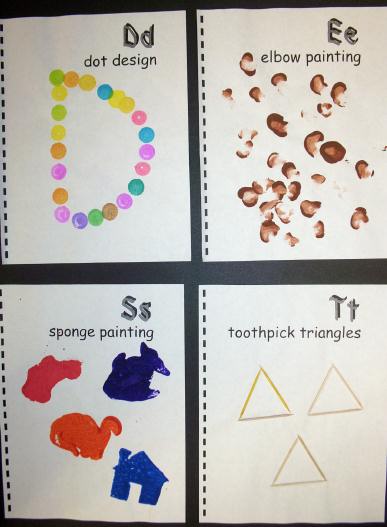
Alphabet Art Book

For the past few years, I have made an Alphabet Art book with my classroom. I used to do a page a week (according to the Letter of the Week), but I recently switched to doing the entire book during the first month of school. It was much better not having to store the books all year. Another plus of doing it this way was that the kids took home their own alphabet book to read all of the time.

I have listed below some different suggestions for each letter of the alphabet. You can pick which one for each letter is more your style. Some people are in to painting and mess more than others so you can choose what you like. 

Aa- apple prints, fingerprint ants
Bb- bubble prints, block prints, blue, band-aids, beans
Cc- cotton prints, car tracks, carrot prints, corn
Dd- dot design (Dot Art Painters), diamonds
Ee- elbow painting, egg shapes, wiggly eyes
Ff- finger painting, draw faces or fish, feathers, flowers
Gg- glitter glue
Hh- hand prints, hearts, hay
Ii- ice cube painting, ink (rubber stamps with a variety of inks)
Jj- junk prints, jewels, jazzy J’s (decorate with lots of stuff)
Kk- kite shapes (draw or precut), keys (rubbings), kleenex
Ll- letter collage (rubber stamps or alphabet punches), ladybugs
Mm- marble painting, mosaic, fingerprint mice
Nn- nature prints, newspaper numbers, nickel rubbings
Oo- O’s (toilet paper tubes), orange (the fruit) prints
Pp- painted picture, purple potato prints. penny rubbings
Qq- quarter rubbings, q-tip painting, quilt (squares of paper)
Rr- rubbings, rainbows, ribbon rectangles, red objects
Ss- sponge paint, stamp designs (rubber stamps), sand, stickers
Tt- torn paper collage, toothpick triangles, tea
Uu- upside-down picture, up arrows
Vv- vegetable prints, valentines
Ww- watercolor, waves, wallpaper
Xx- x-ray (q-tips)
Yy- yarn design, yellow yo-yo’s
Zz- zigzags, zipper rubbing